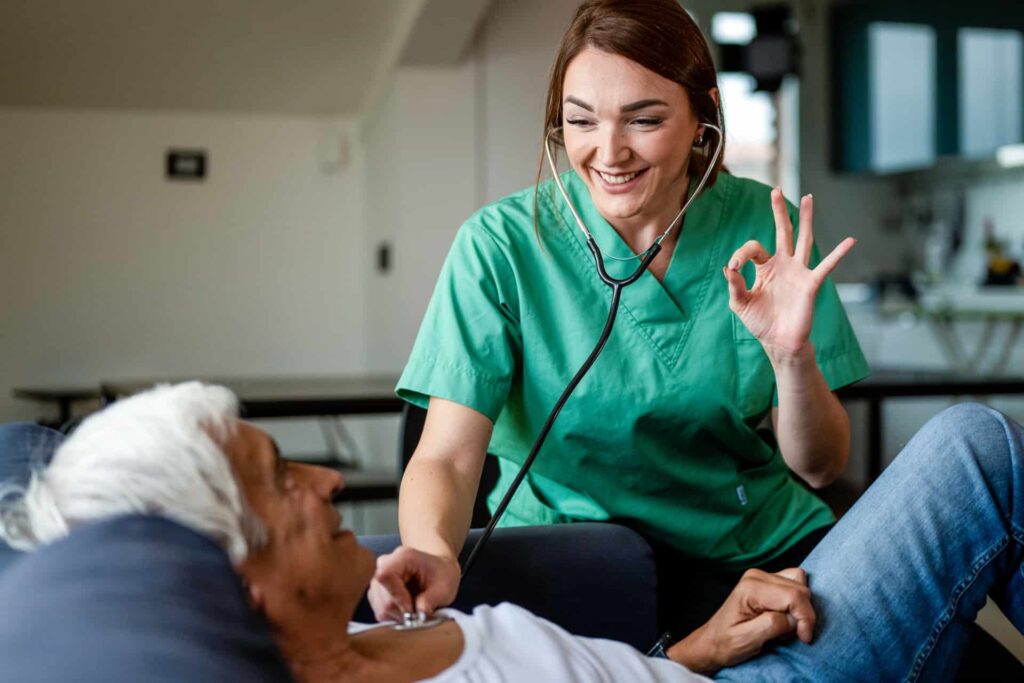
Choosing a career is rarely just about finding a job. For many people; it’s about finding work that feels worthwhile, offers room to grow, and creates the possibility of a more secure future.
Healthcare and caregiving can offer exactly that.
If you’re naturally patient, compassionate, responsible, and comfortable helping people through difficult or vulnerable moments, an assistant nursing career may be worth exploring. The good news is that getting started does not necessarily mean putting your life on hold to attend full-time classes. Online nursing assistant courses make it possible to develop valuable care knowledge while continuing to work, look after a family, or manage other responsibilities.
First Class Caregiving’s online assistant nursing course has been designed to help students move beyond basic caregiving knowledge and develop a broader understanding of healthcare support, client wellbeing, observation, communication, daily care, and professional responsibility.
But what happens once you’ve completed your course?
There’s no single answer because assistant nursing and caregiving skills can be applied in several different environments. Your career may begin in private home care, elderly care, or general caregiving and develop into more specialised care work. You may choose to add dementia or elderly care training, explore opportunities overseas, or eventually pursue further formal nursing studies.
Here are some of the career possibilities worth considering.
What Do Online Nursing Assistant Courses Prepare You For?
An assistant nursing course builds knowledge that sits at the intersection of caregiving and broader healthcare support.
While caregiving tends to focus heavily on assisting a client with comfort, routine, companionship, personal care, mobility, and activities of daily living, assistant nursing introduces learners to additional healthcare-related concepts.
Our online assistant nursing course covers areas such as:
- Activities of daily living
- Client observation and reporting
- Communication with healthcare professionals
- Vital signs
- Medication awareness
- Common illnesses and health conditions
- Mobility and transfer support
- Confidentiality
- Professional conduct
- Person-centred care
- Practical patient-support techniques
Students also have access to step-by-step practical video demonstrations. This gives online learners the opportunity to see techniques demonstrated rather than relying on written theory alone.
That combination can make online nursing assistant courses particularly useful for people who want greater confidence before looking for work in a care environment.
Importantly, however, the exact duties you may perform will always depend on your employer, workplace, qualification, experience, and the applicable laws and professional requirements.
1. Home-Based Caregiver
One of the most natural career opportunities after completing an online nursing assistant course is home-based care.
Many people prefer to receive support in their own homes, particularly older adults, people living with disabilities, individuals recovering after illness or hospitalisation, and people who need assistance with everyday activities.
A home-based caregiver may help a client with areas such as:
- Personal hygiene and grooming
- Dressing
- Safe mobility
- Meals and hydration
- Companionship
- Maintaining daily routines
- General comfort
- Reminders
- Observing changes in wellbeing
- Reporting concerns to family members or relevant healthcare professionals
Every client’s circumstances are different, which is why adaptability is so important.
Home care can also be highly personal. You’re entering somebody’s private space and often becoming part of their everyday routine. Professionalism, confidentiality, patience, dignity, and respect are every bit as important as your practical knowledge.
2. Elderly Caregiver
South Africa has many families looking for compassionate assistance for ageing parents and grandparents.
Some older people remain highly independent but need help with selected daily activities. Others require more regular support because of reduced mobility, frailty, illness, memory changes, or age-related health concerns.
Completing online nursing assistant courses can provide a useful foundation for working with elderly clients because assistant nursing education introduces important principles relating to daily care, health observation, mobility, safety, communication, and client wellbeing.
Students who specifically want to build careers around older adults can also consider complementing their assistant nursing knowledge with specialised elderly care training.
First Class Caregiving offers an online elderly care course for learners who want to develop greater knowledge and confidence in this particular area of caregiving.
Specialisation can help you create a clearer professional direction. Rather than simply saying, “I want to work in care,” you can start developing a career focused on an area you genuinely enjoy.
3. Private Caregiver
Private caregiving is another avenue worth exploring.
Instead of working exclusively through a care organisation, caregivers may sometimes be employed directly by individuals or families to assist a person who needs support at home.
Depending on the client’s needs, private care may involve companionship, mobility support, personal care, meal assistance, routine support, observation, and other activities falling within the caregiver’s permitted scope.
Private caregivers need excellent interpersonal skills.
Technical knowledge matters, of course, but families are also placing considerable trust in the person they employ. Reliability, punctuality, compassion, discretion, and communication can therefore have an enormous impact on your professional reputation.
Positive references and a record of dependable work can become very valuable as your career develops.
4. Care Agency Work
Another possibility is applying to caregiving and home-care agencies.
Agencies help connect trained caregivers with clients requiring assistance. Depending on the organisation, this may provide exposure to different types of clients, care requirements, schedules, and working environments.
For somebody at the beginning of their career, this variety can be valuable.
Working with different clients can help you discover where your strengths and interests lie. You might find that you particularly enjoy elderly care, rehabilitation support, dementia care, companionship, or longer-term home-based care.
First Class Caregiving also provides students with access to career-support opportunities after training, including South African placement programmes. As with any employment pathway, admission to a placement programme shouldn’t be confused with guaranteed employment. Employers make their own recruitment decisions based on their requirements and the individual applicant.
5. Healthcare Support and Assistant Roles
Assistant nursing knowledge may also help prepare learners for selected healthcare-support environments, depending on an employer’s requirements.
In these settings, support staff may work alongside nurses and other healthcare professionals while assisting with appropriate aspects of basic patient care.
The exact job title can vary considerably between employers and countries. So can the responsibilities.
This is particularly important in South Africa, where nursing is a regulated profession.
Completing an online assistant nursing course doesn’t automatically make someone a nurse registered with the South African Nursing Council (SANC). Anyone wishing to practise in a regulated nursing category in South Africa must follow the appropriate formal educational and registration pathway.
We believe students should understand that distinction clearly before choosing any healthcare course.
An assistant nursing course can build useful healthcare-support knowledge, practical understanding, confidence, and experience, but it shouldn’t be presented as a substitute for a SANC-approved professional nursing qualification where such a qualification is required.
6. Care for People Recovering from Illness or Hospitalisation
Not everyone leaving hospital is immediately ready to manage everyday life independently.
Some people may need temporary help while recovering from an operation, injury, or illness.
Depending on the person’s medical situation and the caregiver’s permitted scope, support might centre on safe movement, comfort, hygiene, meals, hydration, routine activities, companionship, and observing and reporting concerns.
This kind of work requires you to understand your boundaries.
A good caregiver doesn’t try to act as a doctor or registered nurse. Instead, they recognise changes, communicate concerns appropriately, follow the agreed care plan, and provide support within their scope of training and responsibility.
That professionalism is one of the most important lessons anyone entering the care industry can learn.
7. Dementia Care
Dementia care is another potential specialisation.
Caring for someone living with dementia presents challenges that are different from many other forms of caregiving. Changes in memory, communication, behaviour, judgement, orientation, and everyday functioning can affect both the individual and their family.
Caregivers therefore need patience, empathy, consistency, and a deeper understanding of how dementia can influence a person’s experience of the world.
If you discover an interest in this area after completing your assistant nursing studies, additional dementia-specific education can be highly beneficial.
First Class Caregiving offers an online dementia care course that can complement broader assistant nursing or caregiving knowledge.
Building several related skills can help you create a stronger professional profile and prepare for clients with more specialised needs.
8. Companion Care
Never underestimate the importance of companionship.
Not every care role centres around complicated physical assistance. Some elderly adults and other vulnerable people may need someone dependable who can spend time with them, help maintain routines, accompany them during everyday activities, and reduce feelings of isolation.
Good companion care still requires professionalism and training.
You need to understand boundaries, communication, confidentiality, dignity, safety, and how to recognise when something may require attention from a family member or healthcare professional.
For people with naturally warm, patient personalities, companion care can be an extremely meaningful field.
9. International Caregiving Opportunities
One reason some students choose online nursing assistant courses is the possibility of eventually looking beyond South Africa.
Caregiving and healthcare-support workers are needed in many parts of the world, and First Class Caregiving’s training is designed with both local and international opportunities in mind.
However, international employment deserves a realistic explanation.
Completing a course doesn’t automatically give you the right to work in another country. Every destination has its own requirements regarding visas, immigration, qualifications, language ability, background checks, professional registration, work experience, and employer sponsorship.
Job requirements can also differ considerably.
If working overseas is your long-term goal, investigate the requirements of your intended destination carefully and confirm them through the relevant official authorities before making financial or career decisions.
First Class Caregiving can help students prepare their skills and explore career opportunities, but international employment ultimately depends on the employer, immigration rules, and the requirements of the destination country.
10. Further Study Towards a Nursing Career
For some students, an assistant nursing course is not the final destination. It is where their interest in healthcare begins.
After gaining care knowledge and perhaps some practical work experience, you may decide that you want to progress further.
That could mean studying additional areas of caregiving or investigating formal nursing education.
Working in care first can also help you understand whether healthcare genuinely suits you.
You learn quickly that care work is both rewarding and demanding. It requires patience, emotional maturity, attention to detail, communication, resilience, and the ability to support people when they may be frightened, uncomfortable, confused, or vulnerable.
If that experience strengthens your desire to become a professional nurse, your next step should be researching recognised nursing programmes.
In South Africa, anyone intending to become registered in a professional nursing category must complete an approved nursing qualification and satisfy the requirements of SANC.
Your previous caregiving or assistant nursing studies may give you useful background knowledge and confidence, but admission to a formal nursing programme will depend on that institution’s requirements.
Why Online Learning Makes Career Development More Accessible
One of the biggest barriers to career development is not motivation. It is time.
You may already have a job. You may have children or relatives who depend on you. You might live hundreds of kilometres from Johannesburg. Travelling to a classroom several times a week might simply be unrealistic.
This is where online nursing assistant courses can make education more accessible.
Our online programme allows you to work through learning material around your existing responsibilities. You can study from home, revisit material, and use practical videos to reinforce what you are learning.
That flexibility can be particularly valuable for:
- Working adults
- Existing caregivers looking to upskill
- People considering a career change
- Parents and family caregivers
- Students outside Johannesburg
- Learners elsewhere in South Africa
- Students elsewhere in Africa or internationally
Flexibility does not mean that online education requires less effort, though.
Successful online learners make time to study consistently, complete their coursework properly, pay attention to practical instruction, review concepts they do not understand, and take responsibility for their own progress.
Your qualification becomes more valuable when it represents genuine knowledge rather than simply course completion.
What You Learn Through First Class Caregiving’s Online Assistant Nursing Course
Our online assistant nursing course is designed to move students beyond basic caregiving and introduce the broader knowledge required in healthcare-support environments.
The course focuses on areas including client care, healthcare knowledge, observation and reporting, activities of daily living, communication, confidentiality, illness awareness, medication awareness, mobility, vital signs, and professional responsibility.
End-of-chapter questions help learners check their understanding as they progress.
Practical video instruction is another important part of the learning experience.
Being able to watch demonstrations can make concepts much easier to understand than reading instructions in isolation. Students can revisit demonstrations as necessary, reinforce their theoretical knowledge, and gradually develop greater confidence around practical care principles.
Our current online course offering also allows learners to access assistant nursing training online, with certification options available on successful completion.
Building a CV After Your Online Nursing Assistant Course
Finishing your studies is exciting, but your next challenge is showing employers what you can offer.
Your CV should clearly communicate your training, any relevant practical experience, additional certifications, and the personal qualities that make you suitable for care work.
Consider highlighting skills such as:
- Client-centred care
- Activities of daily living
- Mobility assistance
- Communication
- Observation and reporting
- Understanding of vital signs
- Personal care support
- Confidentiality
- Compassionate care
- Reliability and professionalism
Additional courses can strengthen your profile further.
For example, a candidate who has assistant nursing knowledge together with elderly care and dementia care education can demonstrate a particular interest in supporting older adults.
Keep copies of your certificates, maintain accurate employment references, and update your CV as your experience grows.
The Personal Qualities Employers Look for Matter Too
Caregiving is unusual because your character matters almost as much as your knowledge.
You can learn procedures and terminology, but excellent care also depends on how you treat people.
Employers and families want caregivers who are trustworthy, respectful, patient, observant, and dependable.
Ask yourself:
- Can people rely on me?
- Can I remain calm when somebody is upset?
- Do I communicate respectfully?
- Can I protect another person’s privacy?
- Am I comfortable helping someone with everyday activities they may find embarrassing or frustrating?
- Can I follow instructions rather than assuming I know best?
- Can I recognise when something is outside my responsibility and needs to be escalated?
These qualities are fundamental to professional care.
A certificate may help you reach the interview. Your professionalism helps you build a career.
Can an Online Nursing Assistant Course Lead to a Long-Term Career?
Absolutely, provided you approach it as the beginning of your professional development rather than the end.
Your first job does not have to be your forever job.
You might begin in general home-based care, gain experience with older clients, discover an interest in dementia care, complete additional courses, build excellent references, and gradually specialise.
Alternatively, your experience could inspire you to pursue formal nursing education.
There are many possible directions.
The most important thing is to keep learning.
Healthcare changes. Client needs differ. Employers have different expectations. Countries have different rules. The caregivers who continue developing their knowledge, communication, professionalism, and specialist skills put themselves in a much stronger position for future opportunities.
Why Choose First Class Caregiving?
We’ve been involved in caregiving education since 1996, and our approach is built around making professional care training practical, accessible, and relevant to real people.
More than 30,000 students have completed programmes through First Class Caregiving, with learners coming from South Africa and further afield.
Our course offering includes areas such as:
- Assistant nursing
- General caregiving
- Elderly care
- Dementia care
- Infant care
- CPR and first aid
- Online learning
- In-class training
For online learners, we place particular emphasis on flexibility and practical video-based education, helping students study around work, family responsibilities, distance, and other commitments.
Most importantly, we believe care education should develop more than technical knowledge.
Professional caregivers need compassion, integrity, patience, responsibility, respect, and a genuine commitment to protecting the dignity of the people they support.
Those qualities can take you a very long way.
Start Building Your Career with First Class Caregiving
If you’ve been thinking about moving into healthcare support, upgrading your caregiving knowledge, or creating new career possibilities, this could be your opportunity to begin.
Our online nursing assistant courses give you the flexibility to learn from wherever you are while developing knowledge that can support careers in home-based care, elderly care, private caregiving, healthcare support, specialised care, and other care environments.
You can also build on your assistant nursing training through additional courses in areas such as elderly care and dementia care, helping you develop skills aligned with the career you want.
A meaningful career does not always begin with a giant leap.
Sometimes, it begins with the decision to learn one new skill, complete one course, and see where it takes you.
Explore our online assistant nursing course and start building the knowledge, confidence, and professional skills to take your next step in care.
FAQs About Online Nursing Assistant Courses
What is an online nursing assistant course?
An online nursing assistant course teaches healthcare-support and caregiving knowledge through digital learning rather than requiring students to attend regular classroom lessons. First Class Caregiving’s online assistant nursing programme covers areas including activities of daily living, client observation, communication, healthcare knowledge, professional conduct, mobility, confidentiality, and other important care principles, together with practical video demonstrations.
Can I complete an online nursing assistant course while working?
Yes. One of the main advantages of online study is flexibility. You can work through course material around employment, family commitments, and other responsibilities, making it particularly suitable for students who cannot attend full-time classes.
What jobs can I apply for after an online nursing assistant course?
Potential opportunities may include home-based caregiving, elderly care, private caregiving, companion care, care-agency work, and selected healthcare-support roles, depending on the employer’s requirements, your experience, and the legally permitted scope of the position.
Does an online nursing assistant course make me a registered nurse in South Africa?
No. An assistant nursing or caregiving course shouldn’t be confused with a professional nursing qualification that leads to registration with the South African Nursing Council. If your goal is to practise in a regulated nursing category in South Africa, you must complete the appropriate approved nursing qualification and meet SANC’s registration requirements.
Can online nursing assistant courses help me find work overseas?
Assistant nursing and caregiving training can help you develop skills relevant to international care opportunities. However, overseas employment is never automatic. Eligibility depends on the destination country’s immigration laws, qualification requirements, employer criteria, experience requirements, and other regulations.
Does First Class Caregiving’s online course include practical learning?
Yes. Practical learning is supported through step-by-step instructional videos. These demonstrations allow students to see care techniques in action, revisit material when necessary, and reinforce their theoretical learning.
Can I specialise after completing an online nursing assistant course?
Yes. Additional training can help you focus on specific areas of care. First Class Caregiving offers related programmes including elderly care, dementia care, infant care, general caregiving, CPR, and first aid, depending on current course availability.
Is an online nursing assistant course suitable for beginners?
It can be. The programme can suit people entering the care sector as well as existing caregivers who want to expand their healthcare-support knowledge. Your willingness to learn, communicate effectively, work responsibly, and provide compassionate care is particularly important.
How can I improve my career opportunities after completing the course?
Build experience, maintain strong references, keep your CV updated, add relevant specialist training, and continue developing your professional skills. Qualifications are valuable, but employers also look closely at reliability, communication, empathy, professionalism, and the quality of care you provide.